Router Jigs


Results for Router Jigs
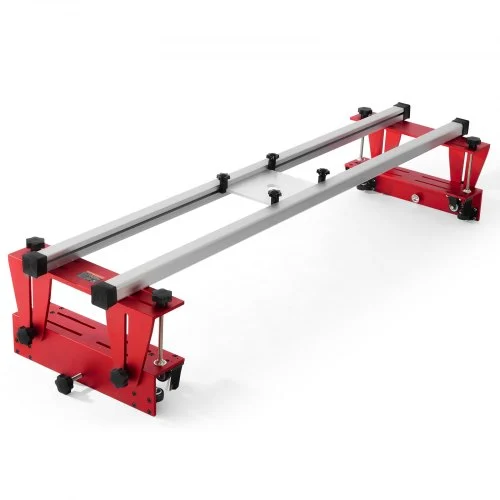
With adjustable rail systems that direct a router across the wood's surface in even passes, VEVOR's router sleds provide woodworkers with a dependable method of flattening live-edge slabs and rough timber without the need for a specialized planer. These sleds for router range from modest kits to 60-inch portable sets for larger materials, whether you're working on a large dining table slab or a small cutting board blank. Locking adjustability produces flat, even results across the full slab width by keeping the router at the same height throughout the pass. Every sled includes core support hardware, and VEVOR's trustworthy after-sales assistance is included with every sled.
VEVOR Router Sleds for Flattening Live-Edge Slabs and Rough Lumber
Don't have a planer large enough to accommodate your live-edge slab? VEVOR's router sleds flatten slabs ranging from small cutting boards to huge dining tables by guiding a router across the wood's surface in even passes using customizable rail systems. Woodworkers can get consistent, flat results without costly milling equipment, specialized shop space, or high upfront costs, thanks to locking height control and portable, 60-inch configurations.
Router Sleds for Length and Adjustability Explained
If you purchase a sled that is too short for your slab, you will have to make several offset passes and hope that they line up. Here's how to match router sleds to your project size.
Choosing the Right Length for Your Slab Projects
When purchasing router sleds, length should be your first consideration because a sled shorter than your slab requires awkward workarounds, like repositioning mid-project, and risks obvious seams when passes don't align correctly. Most dining table- and countertop-sized slabs fit a 60-inch portable router sled in a single setup, letting the router run the full length of the material without repositioning the rail mid-operation.
For smaller projects like cutting boards, charcuterie blocks, and end tables, shorter sleds are ideal since they make setup and storage easier in between uses. Those who frequently flatten larger slabs need the extra reach for consistent results without compromise, while woodworkers who usually make smaller pieces gain little from a longer sled's added capacity.
Rather than sizing for a single large piece, evaluate your average project range before purchasing, since router sleds that are significantly larger than your typical slab dimensions add needless bulk and make storage harder for daily use. A router sled kit sized to fit your actual project range will be more useful day to day than one purchased for a rare, large job you take on infrequently.
Adjustable Rail Systems for Varying Slab Widths and Thicknesses
Using rails that move or extend to match the material currently on the bench, an adjustable slab flattening jig can accommodate slabs of various widths and thicknesses without requiring separate equipment for each size. Because natural slabs seldom arrive in standardized proportions like milled lumber, this adaptability is especially important for woodworkers using a variety of live-edge material.
Rail height adjustment controls how deep the router bit cuts into the slab surface, and fine incremental control directly affects how many passes you need to achieve a fully flat finish. Finer adjustability lets woodworkers remove material gradually and consistently each pass without over-cutting, while coarser increments require more guesswork when determining the proper depth.
For woodworkers who don't want to buy several specialized jigs for various project types, a router sled with a broad rail adjustment range can handle everything from small cutting board blanks to thick dining table slabs using the same base equipment. Before purchasing, compare the specified adjustment range to your usual slab-thickness variation to avoid a capacity gap mid-project.
Locking Mechanisms for Consistent Depth Control
Because any drift in cutting depth during a single pass shows up as an uneven surface once the slab is finished and polished, a Slab Guide Jig with Locking Function holds the router at a set height throughout a pass. By firmly securing the height setting to withstand the pressure and vibration of active routing, locking mechanisms stop this drift.
A slab guide jig with a locking function lets you set the height before each pass and locks it in place against cutting pressure, router weight, and bit vibration from start to finish. With locking controls on VEVOR’s router sleds, you can set the depth and trust it will stay there through the length of each pass with no creep, so the surface stays consistent from the first inch of the run to the last.
Reliable locking also speeds up multi-slab sessions. After confirming the correct depth with a test pass over scrap, lock the height down and run multiple slabs through at the same setting without re-dialing between pieces. The repeatability means all pieces end up at the same final surface height when shops flatten multiple slabs at once. For hobby woodworkers who only occasionally flatten slabs, it cuts down the chance of an overcutting error when the setup hasn’t been used for weeks.
Router Sled Kits: What's In The Box and What To Look For Before Buying
A router sled kit combines the rail system, router mounting plate, adjustment hardware, and connecting components into one purchase so you can get right to flattening without tracking down compatible parts. This matters for anyone new to slab flattening, since components from different manufacturers often need modification to work together. Compatibility issues discovered halfway through setup can be a frustrating puzzle to solve.
VEVOR’s router sleds are kit-style with hardware matched to the rail system, cutting down friction from unboxing to first use. Before you buy, double-check that the mounting plate matches your router base diameter and that you have the right hardware for your installation method. Different routers have different base diameters and depth adjustment ranges, so make sure it will fit before the kit arrives, or you’ll have to find adapter plates later.
For those who want a shop-built solution and have time to fine-tune it, the DIY Woodworking Router Sled made from dimensional lumber and hardware store parts is still a great option for experienced woodworkers. However, assembled kits with precision-machined parts offer better depth repeatability and rail rigidity over time than ad hoc alternatives. If you flatten slabs regularly, not just once in a while, then a dedicated kit will pay for itself in setup speed and consistent accuracy over multiple uses.
VEVOR Router Sleds: Portable & Precision Slab Flattening
Length and adjustability matter, but two practical factors affect how a router sled performs in a real shop: How well does the guide system work on irregular slab edges, and does the setup fit your shop? VEVOR router sleds do both.
Guide Jigs for Slabs & Accuracy in Flattening
The 60-Inch Wood Slab Guide Jig is built for this reality: the guide rails create a level cutting plane regardless of the slab's perimeter, whether wavy, bark-edged, or heavily sculpted. The router runs along the rails, not the natural edge, so the results are consistently accurate, no matter how the raw material looks at the edge.
This is also aided by a bidirectional pass on the Wood Slab Flattening Router Mill, where the router moves in both directions across the slab surface (left to right and right to left), resulting in more uniform side to side material removal and fewer passes required to achieve a uniformly flat finish. The result is a really flat surface, even with badly cupped or twisted starting material, when used with a shimmed or level slab base.
VEVOR router sleds, with a correctly leveled base, create a flat reference plane for the router to follow. Therefore, the starting shape of the slab underneath does not matter regarding the final surface. The rails' rigidity under cutting load ensures accuracy throughout each pass. VEVOR's router sleds use rail construction that prevents flex under the weight of the router and bit pressure, ensuring consistent cutting depth from the first inch to the last without the mid-run sag that can ruin otherwise accurate depth settings.
Portable for Job Sites & Space Saving Shops
Not every woodworker can justify a dedicated slab flattening station. Small shops share floor space between projects; mobile craftspeople work at client locations; hobbyist woodworkers set up the machine on a garage floor when a large slab arrives and pack it away afterward. All three situations are addressed with a portable trimming and planing router machine, assembled for a session and broken down for storage without dedicated floor space year-round.
VEVOR’s router sleds in portable setups feature lightweight rail materials and straightforward assembly hardware for on-site setup without a large toolkit. In cases where the slab can’t be moved, such as a dining table built in a client’s home, on-site flattening is the only realistic solution. This is portable construction without sacrificing the rail rigidity needed for accurate cuts during the routing pass.
VEVOR’s collapsible router sleds are easy to store in a closet or against a wall when not in use, freeing up your work area for other tasks. For woodworkers who flatten slabs periodically rather than daily, that compact stored format is far more practical than a large fixed station that eats up floor space even when it hasn’t been touched in weeks.
Why Choose VEVOR Router Sleds?
VEVOR’s router sleds are available in small kits and 60-inch portable systems with adjustable rails, lockable depth control, and guide-jig designs for the irregular edges of live-edge material. Purpose-built kit components fit together correctly out of the box, and portable designs fit both dedicated shop use and on site work. All at competitive prices, with reliable after-sales support. Browse the full range and cut your next slab clean and accurately. Shop Now VEVOR
FAQs
What length router sled do I need for my slab?
Make sure the sled length fits your average slab size, not just your biggest project. A 60-inch sled can cover most dining tables, although shorter sleds work well for cutting boards and smaller pieces that don't require additional bulk.
Do I need a special router for a router sled?
Adjustable mounting plates work with most conventional routers; however, check the kit's compatibility specifications first. Different brands and models have different router base diameters and depth adjustment ranges.
How many passes does it take to flatten a slab with a router sled?
The slab's thickness and unevenness will determine this, but expect several passes at progressively deeper settings. More precise height-adjustment increments reduce uncertainty and produce more consistent, even results.
Can router sleds handle very uneven or twisted slabs?
Yes, if you use the rail system with a base leveled with shims or movable feet. Regardless of the slab's uneven surface, the guiding jig creates a level plane.
Are portable router sleds as accurate as fixed shop setups?
Yes, as long as the rails can withstand flexing under cutting pressure and router weight. For accuracy, rail rigidity and high-quality construction matter more than whether the setup is permanently fixed or movable.