Arbor Presses








Results for Arbor Presses
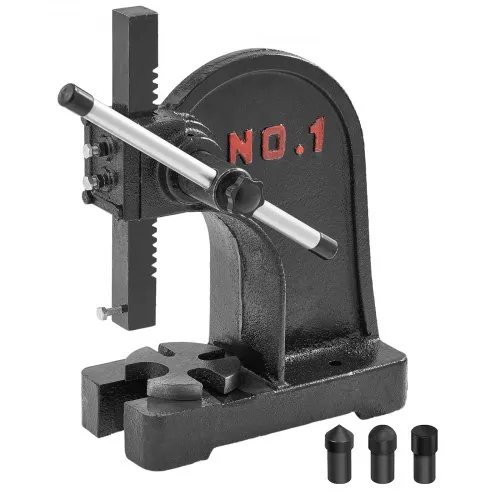
Whenever you try to fit a small bearing into a metal part, using a hammer may seem quick, but one hard hit can damage the bearing or part. That’s why these VEVOR arbor presses give you a more controlled way to apply pressure. It features mechanical leverage built into a bench-mounted frame. They come in 1/2-ton, 1-ton, and 3 ton arbor press capacities to accommodate varying project sizes. Select a small micro arbor press for limited bench space, a manual arbor press with a handwheel for a smooth, controlled fall, or a ratchet arbor press for repetitive precision work.
Why a Dedicated Arbor Press Belongs on Every Workbench
A bent item or damaged workpiece often results from forcing a bearing or bushing into position without the necessary mechanical leverage. An arbor press provides precise placement without guesswork by using a rack-and-pinion or ratchet mechanism to convert hand-applied force into controlled downward pressure. VEVOR's arbor presses match the right press to the parts your shop handles, with a variety of tonnage ratings and operating mechanisms.
Tonnage Capacity and Operation Types
The amount of power an arbor press can safely apply to a workpiece is determined by its tonnage capacity, and the operating method, whether handwheel or ratchet, determines how much control and accuracy you have throughout each press.
1/2 Ton Arbor Presses for Small, Delicate Components
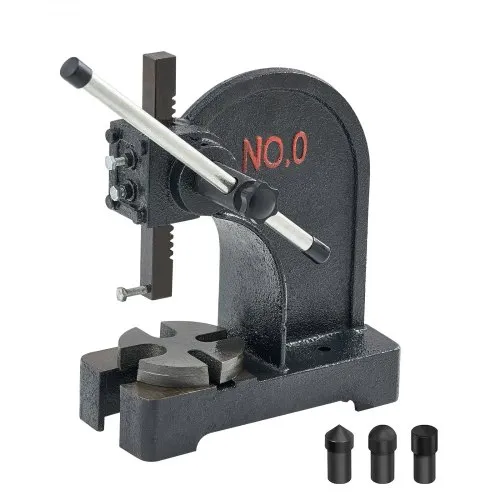
For small-scale pressing jobs like fitting tiny bearings, bushings, or pins into lightweight assemblies where too much power could damage delicate components, a 1/2 ton arbor press is ideal. This reduced capacity gives operators more precise control over applied pressure, which matters when working with components that are not very tolerant of overpressing. Because 1/2-ton units often have a small frame and require little bench space, they work well for limited-space workstations or hobby shops.
VEVOR's 1/2 ton arbor presses are scaled down for lighter-duty applications. This maintains a compact footprint while keeping the press stable during operation. These compact arbor presses suit less frequent or lower-volume pressing jobs because of the lower force ceiling, which also requires less physical effort to move the lever.
A 1/2 ton arbor press provides enough force to seat small parts without risking overdoing it, making it ideal for jewelry making, small electronics assembly, or hobbyist mechanical work with delicate components. Additionally, the smaller scale supports precise workpiece positioning and viewing during each press, which helps when precision placement matters more than raw pressing strength.
1 Ton and 3 Ton Arbor Presses for Standard Shop Tasks
A 1 ton arbor press provides sufficient force for most routine tasks without the bulk of heavier-duty equipment, covering a wide range of basic shop pressing activities from automotive bushings to mid-sized bearing installations. Rather than focusing only on extremely small or very large components, this capacity level works well as a general-purpose press for shops handling a variety of task sizes throughout the week.
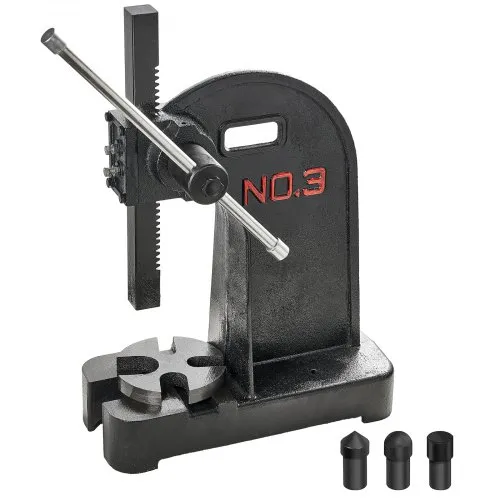
Stepping up to a 3 ton arbor press significantly increases capacity, making it suitable for larger bearings, more durable press fits, and parts that can withstand seating under more force. To handle the extra strain this higher capacity puts on the press body, VEVOR's 3 ton arbor press models use a reinforced frame design that keeps the machine stable even under maximum load. This added strength matters most when working with parts that have tighter tolerances and require more force to seat fully.
Because a press rated too close to your regular maximum gives no margin for extremely stubborn press fits, choosing between 1 and 3 tons of capacity frequently comes down to the hardest task you regularly experience rather than your average assignment. Either capacity offers consistent mechanical power appropriate for typical bearing and bushing installation jobs in automotive shops, industrial maintenance, or general fabrication work involving a variety of part sizes.
Ratchet Arbor Presses for Repetitive Precision Work
Instead of using a single continuous stroke, the operator of a ratchet arbor press can apply force in progressive steps thanks to a ratcheting mechanism on the operating handle. When you press a part into place, pushing too hard can damage it or set it deeper than needed. With our ratchet arbor press models, you can apply pressure in small steps and check the part as it moves.
This ratchet model holds its position as you work. This means you can stop between ratchet clicks to check the alignment without starting over. This is very helpful when you need the same pressing depth on multiple parts.
The ratchet action also uses smaller handle movements. Such a feature can be useful when there isn't much room around the press. Since you will press gradually instead of making one long push, repetitive jobs can feel easier on your hands and arms.
A ratchet arbor press offers a clear benefit over a typical lever mechanism. This is perfect for shops doing high-repetition pressing work where uniformity and reduced operator fatigue both matter.
Manual Arbor Presses with Handwheel for Smooth, Controlled Descent
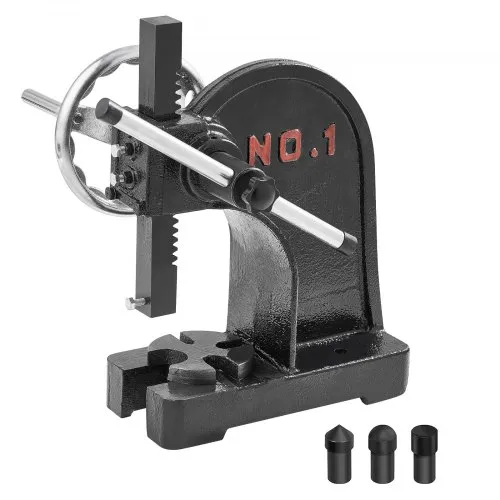
Our arbor presses replaced the typical lever arm with a revolving wheel attached to a rack-and-pinion mechanism. Instead of the step-based motion of a lever or ratchet, a manual arbor press with a handwheel gives the operator smooth, continuous control over ram descent. For parts requiring precise seating tolerances, this continuous control helps operators stop precisely at the proper depth by making it easier to feel minute variations in resistance throughout the press stroke.
The geared mechanisms of VEVOR's manual arbor press with handwheel models convert wheel rotation into a constant downward force. They also maintain steady pressure without the jerkiness that can occur with lever-actuated presses. For sensitive assembly tasks where abrupt force changes could harm a workpiece mid-press, this smoothness is crucial.
Because the geared reduction distributes the effort over the entire wheel rotation, handwheel operation typically requires less physical strength per press cycle than lever-based devices. A hand operated arbor press with a handwheel offers a smoother operating experience for precise assembly operations or operators who prefer fine, continuous control over incremental stepping.
VEVOR Arbor Presses with Duty Rating and Features
Beyond tonnage and operating mechanism, an arbor press's real-world performance over time depends on both the practical construction features it includes and the daily use it is designed to withstand.
Heavy Duty Manual Arbor Presses for Daily Shop Use
The reinforced cast iron or steel frame architecture of a heavy duty manual arbor press is designed to withstand frequent daily operation without developing play or misalignment in the ram mechanism over time. This matters in shops that use the press frequently during the workweek, since prolonged use can wear out lighter-duty frames and compromise pressing precision. Additionally, by reducing rocking or movement that could disrupt part alignment mid-press, the reinforced base helps maintain the unit's stability during operation.
Compared to standard-duty devices, VEVOR's heavy duty manual arbor press models feature thicker frame castings and broader base plates, which distribute operational stress more evenly throughout the structure. Even after months of frequent shop use, this construction method helps maintain consistent pressing accuracy by reducing the chance of frame flex under repeated heavy loads.
Investing in a heavy-duty design reduces maintenance needs. It delivers more reliable long-term performance for shops that use an arbor press as essential everyday equipment rather than a tool for infrequent use. Because a frame prone to flex under load impairs precision pressing operations that depend on it, increased stiffness also lets higher-tonnage applications be handled more reliably.
Large and Compact Arbor Press Frame Options
A large arbor press can accommodate workpieces that wouldn't fit in the working area of a smaller press by expanding throat depth and overall frame size compared to conventional units. For shops working with larger components, such as bearing housings or extended shaft assemblies, where a compact frame doesn't leave enough room to place the item beneath the ram, this increased capacity matters.
A micro arbor press, at the opposite end of the size range, trades maximum workpiece size for portability and lower counter space requirements, with a small footprint suited to tabletop operation in confined workshops. From huge arbor presses designed for massive components to compact arbor press models for detail work and smaller-scale shops, VEVOR's offering covers the full spectrum.
Since a high-tonnage press cannot accommodate an enormous workpiece with a shallow throat, the choice of frame size ultimately depends on the physical dimensions of the parts you frequently work with, not merely their weight or the force required to press them. Matching the frame size to your regular part dimensions ensures the press works well for the projects that come through your shop.
Why Choose VEVOR Arbor Presses?
VEVOR carries a full range of arbor presses in both compact and large-frame configurations. All models feature integrated ratchet and handwheel operating mechanisms. They range from 1/2 to 3 tons. Each device provides the mechanical leverage needed to precisely seat bearings, bushings, and pins, from heavy duty manual arbor presses to mini arbor press models. Equipping your bench with the appropriate arbor press is simple with VEVOR's trusted after-sales assistance. Explore the entire selection now and press parts with assurance and accuracy.
FAQs
What ton capacity do I need for automotive bearing work?
Depending on the part size and press-fit tightness, most automotive bushing and bearing jobs have capacities between one and three tons. Select capacity based on your most challenging frequent task rather than the average.
Is a ratchet or handwheel arbor press more precise?
Both provide excellent control, but handwheel types offer smoother, continuous control that suits delicate seating tasks. At the same time, ratchet presses excel at incremental, step-by-step force for repetitive work.
Can a 1/2 ton arbor press handle general shop tasks?
It works well for smaller parts like light bushings or pins. A capacity of one ton or greater usually provides more useful daily force for general automotive or industrial pressing jobs.
What's the benefit of a large arbor press over a standard frame?
A large arbor press can accommodate larger workpieces that wouldn't fit within the limited working area of a regular or micro frame, offering greater throat depth and clearance.
Do heavy-duty arbor presses require special maintenance?
Routine maintenance keeps the rack-and-pinion or ratchet mechanism running smoothly. In addition, heavy-duty frames are designed to require less maintenance under regular shop use.